

While I’ve written characters with mental illnesses before (Alina and Evangeline specifically), Lady Rose in Hold Her Close is the first I’ve written with a chronic or physical illness. She has what would these days be known as endometriosis, though it was very much an unknown back in the middle ages. Would it have caused her to be barren as the healer diagnosed? Not necessarily. But with so little knowledge, I imagine they would have thought so.
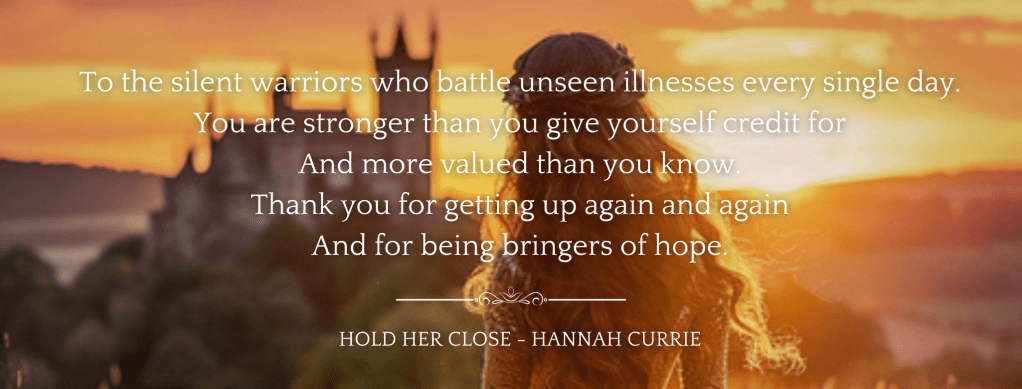
One of the things I really appreciated writing into Hold Her Close, and Rose’s journey, was a lot of the thoughts and emotions that go with having a chronic, or invisible, illness. The doubts, the strength, the hopes, the struggles, the fears and wondering. Some of them came from my imagination of what it would be like to have such an illness as a princess in the middle ages, but a lot came from my own life.
See, when I was eighteen, I was diagnosed with rheumatoid arthritis. Short explanation, my immune system thinks my body is the enemy and tries to fight itself, resulting in painfully swollen joints, fatigue, and various other fun things. Even shorter explanation, I have a chronic disease.
I can’t speak for others, but for me, the hardest part right from the start was that no one could see it. I didn’t lose all my hair from chemo treatments (although I’ve lost a lot), or have a cast, or crutches. I don’t have physical scars or an oxygen tank I carry around or anything like that. I was in pain— physically and mentally—but no one could tell. And I didn’t know how to tell them. I remember once early on being so wiped and dizzy that I couldn’t get up from a couch to set up for an event I was helping lead. One of the team joked that I was lazy and I just about burst into tears because they had no idea the war going on inside me. How much I ached to be helping like the rest of my team, how much pain I was in, and how I’d been lying there on the couch berating myself already while battling whether I could help set up tables anyway. Then there was the guilt. The feelings of worthlessness. The wondering if I’d ever be useful again. The words I wanted to say but couldn’t find.
I’ve learnt a lot from having a chronic disease. I’ve learned about medications and how the body works (or doesn’t work), what different doctors do and what blood tests test. I’ve learnt empathy and the strength it takes to keep going when you just want to stop. I’ve learnt how dark and terrifying and life-altering depression and anxiety can be. I’ve learnt faith and what it means to truly cling to hope. I’ve learnt that everyone has a story, and some of the most powerful ones come from those who are still trying to find the words to tell it.
I still struggle to find words to explain—no one wants a lecture when they’re just asking if you’re okay or making an offhand comment—but here are eight things I wish I could tell people about having a chronic, or invisible, disease:
1 – Yes. I still have it.
I accidentally laughed in the face of a friend I hadn’t seen for a while when RA came up in the course of a conversation and she asked, “Oh, you still have that?” Um, yes. Chronic means I’ll have it for life. It’s not going away. It might be controlled by medication or other means, or even go into remission for a period, but it’s something that—short of a healing miracle—I’ll have for the rest of my life.
2 – Just because you can’t see it, doesn’t mean it’s not there.
There might be signs—my fingers might swell or I walk with a limp for a bit or something like that—but highly likely, you’re not going to be able to see the pain. It’s invisible. Much like mental illness or chronic fatigue or cramps. Maybe I don’t want you to see it, maybe I don’t know how to show it (or am tired of trying to explain or be doubted) but it’s there. It’s very real for me.

3 – Just because it’s every day doesn’t mean it hurts less
“Shouldn’t you be used to that by now?”
Truth is, yes. I am used to it. Used to the ups and downs of pain and the rollercoaster of uncertainty not knowing one day to the next how I’ll feel. Used to rejoicing in the good days and just getting on with it on the bad ones. Used to pain striking unexpectedly and the only explanation being ‘it’s just your RA’. Used to frequent blood tests and balancing the pros of medication with the cons of their side effects. Yes, I’m used to it, but it’s still pain. It still hurts. Sometimes a lot.
4 – Some days, it’s more mental than physical
Actually, often it is. I can deal with the physical pain. I’m used to that (see point three above). It’s the mental battle that gets me down. The knowledge that my 100% these days isn’t even close to what it used to be before I had RA. The constant feeling that I’m letting people down—my family, my friends, my readers. The wishing I could be more. That I could do more. When I just want to be ‘normal’ again. When I look at how much I cost my family in medication and think of all the things we could be spending that money on instead. It takes a lot to fight back those lies and remind myself that I’m not a burden, that who I am today is as valuable as I was before I had RA even though I’m not involved in as many things. That I’m still a good writer when I write slow rather than publishing multiple books a year. To remind myself of all I’ve learnt, and how much I’ve grown, through having a chronic disease. That I’m who I am today because of it.
It’s all stuff I know, but some days it’s a battle to remember.

5 – Everything goes through the pain or illness filter
“It might not be all of who I am, but it is part of me. A very big part. It’s never going away. Every decision I make is impacted by it. I choose my clothing based on how painful my stomach is and how tight a belt I can stand. I choose what I eat and drink, and how much, depending on my nausea. When someone asks me to go with them—even just for a short walk—I have to consider whether I have the strength, whether I can walk back again, who might be there to help me if I fall, if the time spent with that person is worth the amount of energy it may take. What I do, where I sit, the people I speak with, the places I go—when you only have a scant amount of strength, everything becomes a choice not of whether I want to do something or not but whether I can.” (Lady Rose, Hold Her Close)
While I don’t have the same illness as Rose, the thinking is the same. Whether it’s a good day or bad day, the thinking (and overthinking) is constant. Some days I switch it off and ignore the consequences (see point six, below) but that has to be a deliberate thing.
6 – Sometimes I push myself to do something, even though it hurts (or really will tomorrow)
There are three main reasons for this:
- To prove I can, or that I’m still ‘good enough’ to myself or someone else. Never underestimate the power of a mental win. Constantly being careful can really play on your mind (see points four and five, and this post I wrote about taking risks) and be really demoralizing.
- Health can be really unpredictable. RA has a mind of its own sometimes. Tomorrow might be better or it might be worse. But today? Today, I can. So I will.
- Family. I’ll do anything for family—those related by blood and those I’ve claimed. They’re worth it. Every time. Day out with my family walking tens of thousands of steps around theme parks or bushwalks? Worth it. Flying to the other side of the world to meet new friends and witness God answering a prayer in a way I couldn’t imagine? Worth it. A full day or two at a conference? Worth it. Going to the playground with my littlest when I’d rather sleep? Worth it. Every time.

7 – Sometimes the hardest question to answer is, “How are you?”
It’s that physical v mental thing again. I can be great physically but mired down in anxiety, or in incredible pain but having a great day because my head’s in a really good place. Or I’m good one minute and struggling again the next, or hanging in there but know I’m teetering and one thing will send me over the edge. Or…
There are days when I feel completely normal and RA is a minor irritation at worst. It barely even gets a second of thought. Then there are others when I just want to curl up in a ball and sob for hours because it’s all too much and I’m so tired of fighting. Some days, they’re the same day. I go away and wonder if I lied by saying I was okay when, an hour later, I’m not. Or the opposite. I burst into tears when you ask only to later be totally fine and wishing I hadn’t said anything at all because now you think I’m not doing well when actually, I’m great and it all feels like a total overreaction on my part even though I know it was true at the time.
Was it a lie? Did I tell the truth? Was it the whole truth? Did that person need to know the whole truth? Were they just asking to be polite? Do they want the whole answer? Are they going to understand? Is it worth trying to explain?
8 – It’s not all bad
Yes, having a chronic disease and dealing with pain is, for lack of a better word, a pain. But it’s not all bad. I have grown so much from having it, especially when it comes to empathy toward others and my relationship with God.
I know what it’s like to fight depression and anxiety and have a greater compassion for others who also struggle with them. I know what it’s like to doubt, and have God blow those doubts away with His goodness. I’ve learnt that it’s okay to question God and have days when I’m not okay. I’ve seen firsthand God’s faithfulness over and over again. My stories and characters are deeper because of it. My relationships with others too. I’ve met amazing people, and come to have a great respect and appreciation for the medical system in Australia.
I am who I am because of what I’ve been through and, even if I could, I wouldn’t change that.

Will I post this and second guess for the rest of the day/week/my life whether I should have? Highly likely. There’s a reason I don’t talk much about having RA and the emotions that go with it.
But on the off chance it’ll help someone, maybe open a conversation or help a friend with a chronic illness, I’m posting it anyway. Putting it out there. A bit of my story.
I hope it helps.

 Hannah Currie
Hannah,
Your openness to allow your readers in to your private world of chronic illness is inspiring. It’s one thing to have a chronic illness and it’s another to have the courage to work through each day, to have pure faith, and that’s exactly what you have.
You and the messages in your books are incredible!
LikeLiked by 1 person
Thank you so much for sharing this story of your health. I feel so encouraged by it, more than I can say. I can relate to all of your “things you would say” and it helps to feel I’m not alone in it. Although I wish you weren’t going through them! You are an amazing author and person. You will be in my prayers.
LikeLike
Thank you for sharing this story of your health. It means so much to me, more than I could say. I am so encouraged by all you shared, and can relate to it all as well. I wish you weren’t going through this, but thank you for being open about it and helping me feel not so alone. You are an amazing author and person. You will be in my prayers.
LikeLike
Hannah, thanks for sharing. So many people are dealing with issues that are invisible to the rest of the world. That’s why we need to treat everyone we encounter each day with compassion. You never know what’s going on in their lives. Our daughter has two autoimmune blood diseases (CVID and ITP) and a person would never know that she has the immune system of an 80 year old so it’s a constant battle to avoid getting sick. She deals with so much just managing these issues as a young adult. We’re so proud of her for keeping on keeping on. Blessings to you, hopefully someday there will be a cure for your disease and all other inflammation-based diseases. Take care!
LikeLike